



Working on the Outside: Advanced Amateur 16mm Filmmaking in the Midwest, 1942–1977
Unlike the professional filmer bound by commercial obligations,
you are unfettered by the necessity for approval; with time
working for and not against you, you may roam the world,
recording it, reporting it, shaping and reshaping it to suit your
creative desires. This freedom gives rise to the unexpected and
it is the unexpected that gives the amateur film its unique flavor.
– Amateur filmmaker Margaret Conneely, 1955¹
In 2024, Chicago Film Archives received funding from the National Film Preservation Foundation to preserve five short midwestern amateur films: Obey Your Air Raid Warden (1942), Dancing Flowers (1946), The Switch (1961), Back Alley Rip-Off (1970), and Games for Married Men (1977). Made far from the commercial filmmaking hubs of the coasts, these playful amateur sound films capture a unique slice of midwestern life and offer insight into the social and aesthetic dimensions of an alternative film culture of small-scale movie production and circulation. While these films were made under a wide variety of circumstances over a span of 35 years by filmmakers of different backgrounds, they are all technically ambitious, idiosyncratically personal, distinctly regional, and decidedly non-professional. The filmmakers were not part of either the commercial or avant-garde film worlds; they were instead in their own worlds, and that allowed them to produce films that were strikingly singular. They were resourceful and abundantly creative, and while their films can be rough around the edges, that’s where a lot of the charm and appeal is; not because the imperfections are something to laugh at, but because there is something immediate, strange and exciting going on in these ambitious yet off-kilter productions.
In addition to being remarkable films, their existence on the fringe makes them both peculiarly exciting and particularly vulnerable.² Lone acetate reversal prints were all that existed for most of these titles. Working from CFA’s elements, Colorlab has photochemically preserved these five titles to 16mm polyester film with optical soundtracks.

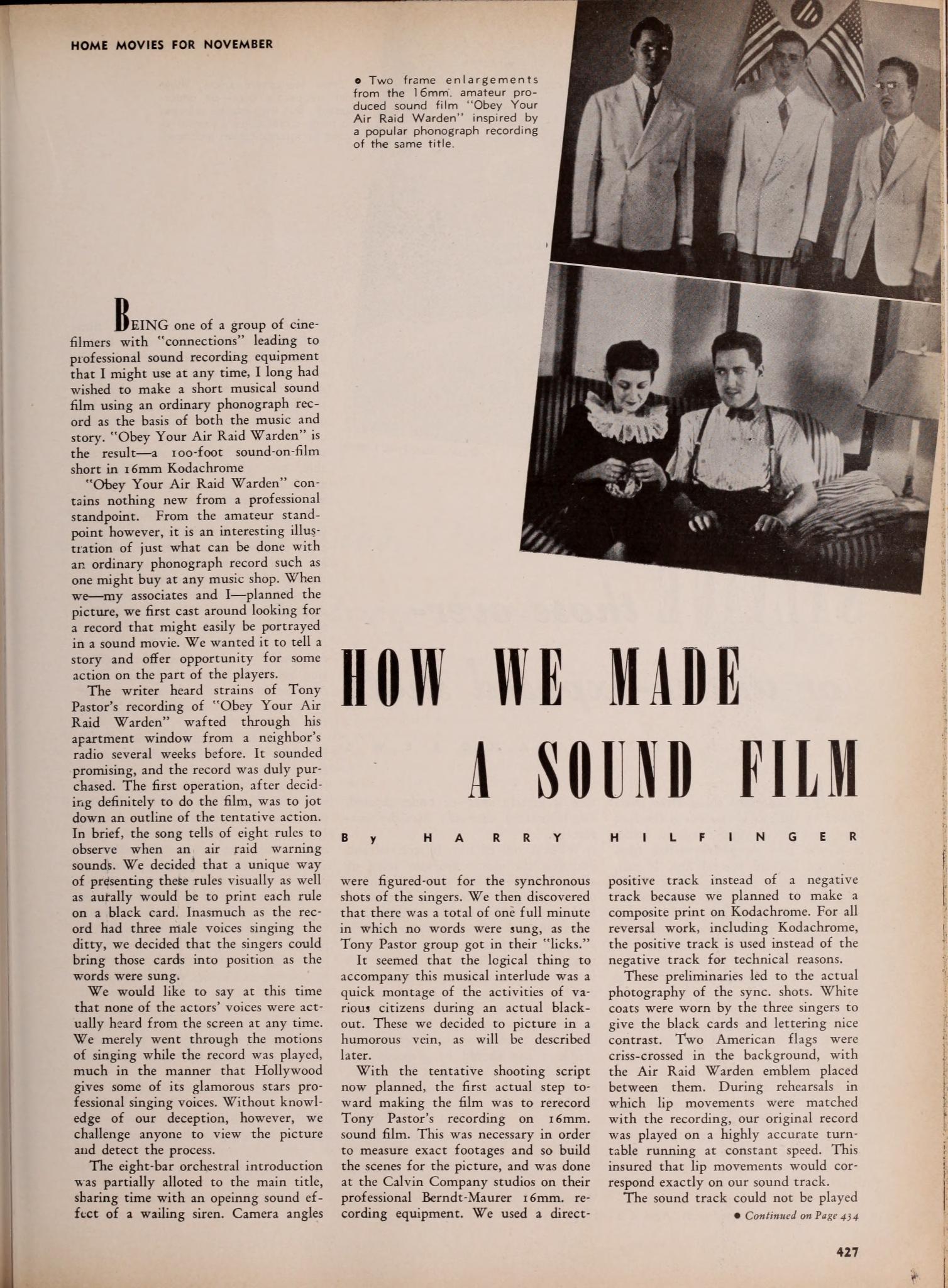
In Obey Your Air Raid Warden, a trio of Kansas City, Missouri friends come together to parody the popular song (and public service announcement) by Tony Pastor and His Orchestra, which instructs on eight rules to observe when an air raid warning sounds. Over the course of 3 minutes, Robert Davis, Harry Hilfinger, and friends employ a variety of props, settings, and sound effects to produce a humorous response to the horrors of World War II.
As discussed by Hilfinger in the article “How We Made a Sound Film” in a 1942 issue of Home Movies,³ this oddball cultural artifact was made purely as an exercise in DIY sound-on-film filmmaking. Hilfinger ran ESO-S Pictures, one of the first full-service home movie stores in the country. Davis, who founded the 8-16 Home Movie Makers ciné-club of Kansas City, won numerous awards on the amateur film circuit and went on to become a successful travelogue filmmaker with his wife and business partner Theresa Landbeck Davis.
The film is part of the Robert & Theresa Davis Collection, which was donated to CFA by Theresa in 2012.
Dancing Flowers is an amateur stop-motion film of potted primroses dancing in sync to a Strauss waltz. John Nash Ott made the film over the course of five years while he was working a day job at First National Bank of Chicago in the 1940s (taking a break to serve in the Navy from 1943 to 1945). As explained in his memoir My Ivory Cellar: The Story of Time-Lapse Photography, in order to control the movements of the plants, Ott created special pots with automated heating elements, water tubes, and wheels with the help of a young machinist from the village blacksmith shop. To make the primroses ‘dance,’ the heating elements were turned on to wilt the leaves down, then the plants were given just the right amount of water to revive them again, and a battery of lights was programmed to attract the leaves from side to side. The flower pots were pulled around on a track at a speed of about one half inch per hour.⁴
Ott was self-taught in both filmmaking and gardening. He started tinkering with time-lapse plant photography in 1927; during the 1940s, he gained a reputation as an amateur filmmaker and gardener, lecturing and showing his time-lapse films on the Garden Club circuit. He would go on to make educational films using time-lapse plant photography, and hosted a weekly gardening show on Chicago television called How Does Your Garden Grow?, the first show broadcast in color by Chicago’s NBC affiliate. In 1953, the Chicago Tribune called him “the planet’s most renowned botanical motion picture photographer and the time-lapse film authority.”⁵
The film is part of the John Nash Ott Collection, which was donated to CFA by the Winnetka Historical Society in 2022.
The Switch is a cheeky ‘scenario’ film directed by Margaret Conneely and produced by Chicago’s Metro Movie Club. When two women discover that their husbands have been renting dirty 16mm movies, they create and swap in their own film to tease them.
The Switch is exemplary of the kinds of quietly subversive productions modest ciné-clubs were able to achieve through creativity and collaboration. The film was given an Award of Merit by the Toronto Movie Club and the Photographic Society of America (Motion Picture Division) in 1961, and was screened at that year’s convention. It also screened at the 1971 Society of Amateur Cinematographer’s Convention, representing Metro Movie Club in the “Salute to the Movie Clubs” program. Several of Conneely’s other mischievous mid-century films won awards from major amateur contests in both America and Europe.
The film is part of the Margaret Conneely Collection, which was donated to CFA by Conneely in 2005.


- Bruce Engels, Hans Zorn and Margaret Conneely on the set of The Switch.
All photos from CFA's Margaret Conneely Collection. - Margaret Conneely holding a Bolex camera on the set of The Switch
- Margaret Conneely behind the scenes on the set of The Switch
- Cast and crew behind the scenes on the set of The Switch
- Margaret Conneely measures the focus distance on the set of The Switch
- Kathy Holch and Margaret Conneely behind the scenes on the set of The Switch
Back Alley Rip-Off is an unfinished fiction film by Chicago muralist Don McIlvaine, shot in the North Lawndale neighborhood with local actors. It follows two men that win a sweepstakes lottery, and the people who want to take the winning ticket from them (including a mobster, a preacher, and a man who wants to use the money to improve the neighborhood). Several of McIlvaine’s now-demolished murals provide vibrant backdrops to this technically sophisticated tale of life on the West Side.
Back Alley Rip-Off was made while McIlvaine was serving as director of Art & Soul, a youth art center that grew out of a collaboration between the Museum of Contemporary Art and the Conservative Vice Lords. As discussed in Rebecca Zorach’s 2019 book Art for People’s Sake: Artists and Community in Black Chicago, 1965-1975, McIlvaine was “interested in developing the talents of his young students as media makers themselves—as he also sought to make art that incorporated an authentic voice of the street.”⁶ Zorach details that Back Alley’s script was “inspired both by local context and by the sense of possibility in Hollywood’s newfound interest in Black subject matter that spawned the blaxploitation trend,” elaborating that “the very character types suggest conflicting values: honest depiction, entertainment appeal, and the ‘positive images’ of the Black Arts Movement. Though the fiction film was obviously intended as a comedy, it also addressed the goal of portraying ‘community activities’ and ‘behavioral patterns related to environmental surroundings’—thus channeling youth ‘into constructive creative occupations.’”⁷
The film is part of the Don McIlvaine Collection, which was donated to CFA by McIlvaine’s widow Herjuanita McIlvaine in 2013.
Games for Married Men is a dark comedy produced by Central Cinematographers, an invite-only group of “advanced amateur” filmmakers in Chicago who met once a week to produce short narrative films while rotating roles and responsibilities.
Heavy on Chicago iconography, this convoluted tale of diamonds, train station lockers, and infidelity digs into the sleazy underbelly of midwestern, middle class life while still remaining wholesomely humorous. It’s a unique tone which Games shares with many of the films produced by Chicagoland ciné-clubs: films that were often preoccupied with racy subjects like sex, murder, and marital strife, but almost always viewed through a naive and playful lens.
The film is part of the Margaret Conneely Collection (Conneely was a founder of Central Cinematographers and did lighting on this film).
Many thanks to the National Film Preservation Foundation and Colorlab for their help in preserving these films for the future!
If you are a programmer or curator interested in showing one of these films, please contact us.
____
¹ “Cine Continuity” lecture notes. Margaret Conneely Collection (C.2005-01), Box 1, Folder 8, Chicago Film Archives.
² According to Charles Tepperman’s Amateur Cinema 1923-1960: The Rise of North American Moviemaking (Oakland: University of California Press, 2015: 11), fewer than 10% of award-winning and honorable mention amateur films are known to be extant. The number is likely lower for less heralded amateur works.
³ Harry Hilfinger, “How We Made a Sound Film,” Home Movies, November 1942: 427, 434-435, https://archive.org/details/homemovies194209verh/page/n473/
⁴ John Nash Ott, My Ivory Cellar: The Story of Time-Lapse Photography (Winnetka: John Ott Pictures Inc., 1958): 19-21.
⁵ Anton Remenih, “John Ott’s Films Need Color TV and Vice Versa,” Chicago Daily Tribune 21 June 1953: 16.
⁶ Rebecca Zorach, Art for People’s Sake: Artists and Community in Black Chicago, 1965-1975 (Durham: Duke University Press, 2019): 277.
⁷ Ibid: 278.