



 WHEN: Wednesday, October 14, 2026 at 6:30pm
WHERE: Epiphany Center for the Arts, 201 S Ashland Ave
ADMISSION: FREE
THE PROGRAM
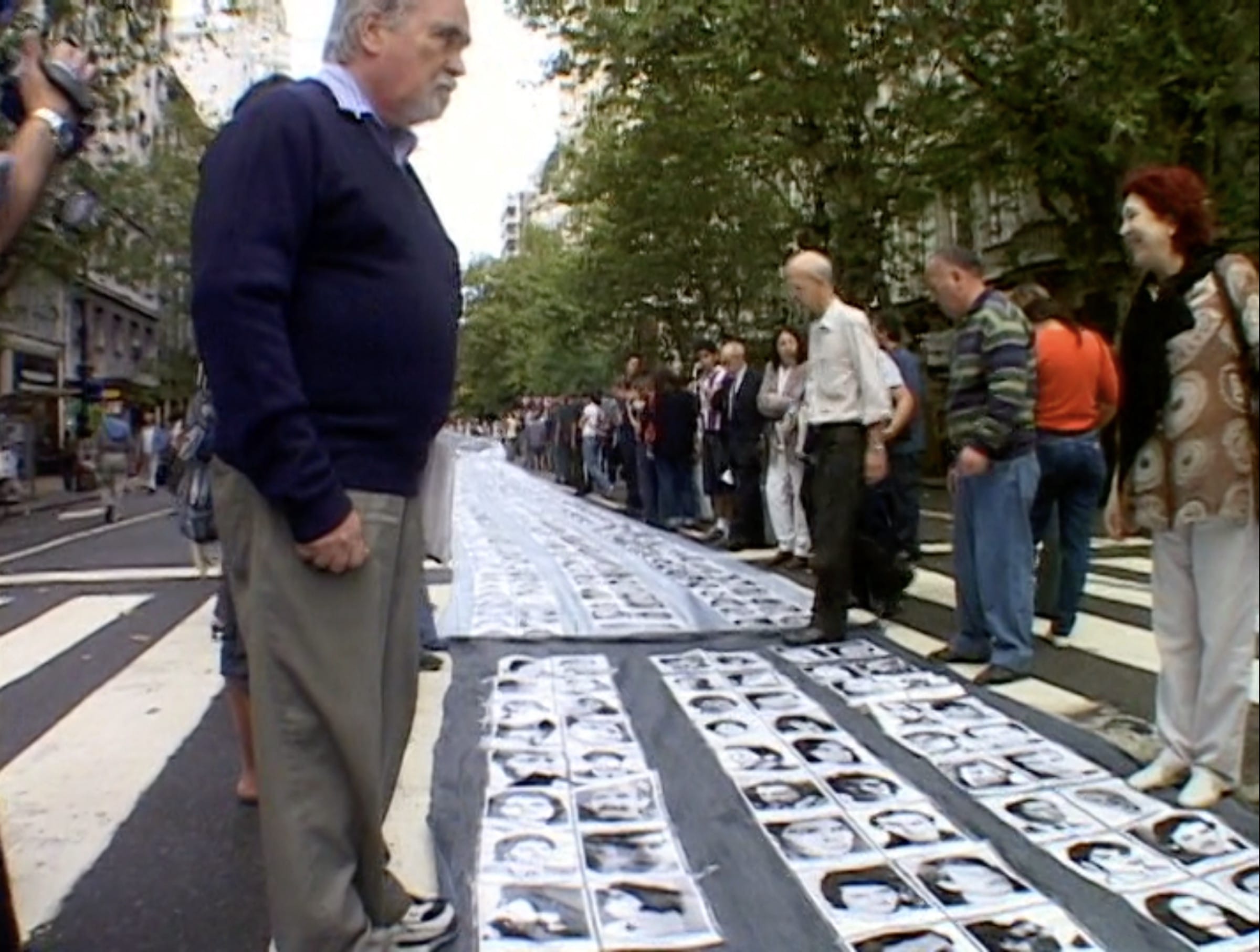
BURNT ORANGES (2005, Silvia Malagrino, 90 min)
Presented by Nissa Rhee, journalist and cofounder of Borderless Magazine, and followed by a post-screening conversation with director Silvia Malagrino and writer Monica Flores Correa.
Born in Buenos Aires, Silvia Malagrino left Argentina in 1978 when her life as a young university student became dangerously entangled with politics surrounding the “Dirty War” and the resistance movement which materialized under one of Argentina’s most brutal military dictatorships. In the midst of the disappearance of so many young protestors and their friends, Malagrino left her country of birth and settled in Chicago. While earning her Ph.D. at the University of Illinois-Chicago, she built a career as an educator, multimedia artist, photographer, and filmmaker. In the mid-1990s she returned to Argentina to film and record the voices of mothers and grandmothers whose children had been “disappeared” in the resistance. As Robert J. Fox, chief editor of the Buenos Aires Herald, famously said of those times, “All of the institutions in Argentina failed. The only institution that didn’t fail was motherhood.” In her film, Malagrino includes her own voice among the others as she synthesizes her memories and experiences of those dangerous years. Burnt Oranges, is a very personal and poetic memoir of this war and its continuing aftermath.
 Nissa Rhee is an award-winning writer, editor, and entrepreneur with over 20 years of experience in the journalism industry. She cofounded Borderless Magazine in February 2017 and led the news outlet as executive director until June 2026. She now serves as Editor-at-Large at Borderless, supporting the team by editing investigations and enterprise stories. As a visionary media leader, Nissa transformed Borderless—a nonprofit and nonpartisan news outlet reimagining immigration journalism—from a blog to a nationally recognized, award-winning newsroom with a dozen employees. In 2025, the MacArthur and Field Foundations named Nissa a 2025 Leader for a New Chicago for her work as a “compassionate storyteller.” Prior to Borderless, Nissa spent over a decade working as a reporter and editor in the U.S. and Asia. She also taught journalism at Northeastern Illinois University and trained Ukrainian refugee journalists in Greece as part of the U.S. State Department’s TechCamp program.
ABOUT THE INSIDE/OUT SERIES
Displacement implies a concept of home. At its best, home is a place where love, belonging and safety comfortably reside.
Chicago Film Archives presents Inside/Out: Stories of Origin and Dis/Placement, a series of four extraordinary films made by four Chicago-based women who by nature are adventurous, deeply curious, and brave. They are also mostly unheard of until now.
The concept of “displacement” is securely embedded in each of their stories, whether it resides within the communities they film or within their own lived experience. Although each filmmaker offers a narrative distinctly different from the others, efforts to survive and adapt to displacement surface throughout all of their films.
To better understand the effects of displacement, it may be useful to consider the concept of home: What does it mean to “feel at home”? Is “belonging” synonymous with “home”? Is having a sense of “home” essential to the well-being or understanding of self? Does “home” reside in a structure, a person(s), a country or a culture? What might be lost or gained when one is displaced?
To explore these concepts and considerations, Alexandra Salomon, Senior Editor with Chicago Public Media, Nissa Rhee, cofounder of Borderless magazine and a seasoned writer, editor and entrepreneur in the field of journalism, and Natalie Moore, a Chicago-based journalist and author of The South Side: A Portrait of Chicago and American Segregation, will facilitate conversations around these four films and how “displacement” and its consequences are woven throughout lives in each story.
PROGRAMS IN THIS SERIES
All screenings will take place in The Sanctuary at the Epiphany Center for the Arts (201 S Ashland Ave in Chicago).
Admission is FREE.
—
Wednesday, September 16, 2026 at 6:30pm
A NICE PLACE TO LIVE (1974, Maria Moraites, 55 min)
Presented by journalist Natalie Y. Moore and followed by a post-screening conversation with Deondré Rutues (a social justice advocate, community leader, and business psychologist on the west side of Chicago) and Pastor Marshall Hatch, Jr. (pastor at the New Mount Pilgrim Church-Chicago and cofounder and Executive Director of the MAAFA Redemption Project)
Wednesday, September 23, 2026 at 6:30 pm
MI RAZA: PORTRAIT OF A FAMILY (1972, Susan Stechnij, 30 min)
Presented by journalist Alexandra Salomon and followed by a post-screening conversation with director Susan Stechnij, Carlos Arango, former director of Casa Aztlan, and Norma Seledon, Director of Leadership, Development & Capacity Building at Equality Illinois.
Wednesday, October 7, 2026 at 6:30pm
STREET SIGNS: MURALS IN CHICAGO (1990, Susan Dobinsky & Julia Kurtz, 30 min)
Presented by journalist Alexandra Salomon and followed by a post-screening conversation with director Susan Dobinsky, artist Sandra Antongiorgi, and photographer Ivan Justiniano.
Wednesday, October 14, 2026 at 6:30pm
BURNT ORANGES (2005, Silvia Malagrino, 90 min)
Presented by Nissa Rhee, journalist and cofounder of Borderless Magazine, and followed by a post-screening conversation with director Silvia Malagrino and writer Monica Flores Correa.